Senet Board
The Senet was one of the favorite games from which the ancient Egyptians gained great enjoyment. Dating back to the Predynastic Period, the game was first found in a tomb near Abydos, in Luxor. Archeologists found the name of the game within a list of objects carved on the walls of the Tomb of Rahotep (of the Fourth Dynasty). Later in the New Kingdom, the game became very widespread and acquired a magical and religious functions involved in some funeral rituals. The last Senet board found dates back to the Ptolemaic Period and was discovered in the Tomb of Petosiris, the High Priest of Thoth.
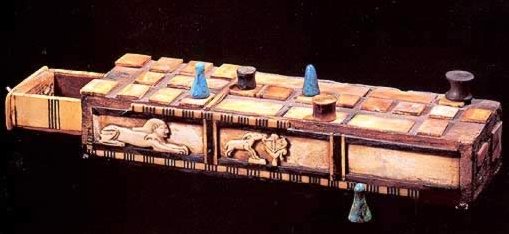
Found in the Tomb of Horakht, this particular Senet board comprises of a number of squares known in Egyptian as 'peru' (which mean 'houses') resting on a rectangular board. There are three panels on the sides of the board, two adjoining ones of which are decorated with raised bone carvings with the shapes of a goat (middle) and a sphinx (left). The pieces which are placed on the squares differ in shape, color, and material: some of them are conical in shape and are made from faience while others have the shape of bobbins and are made from ebony. Players move the pieces according to the fall of sticks they throw. Interestingly, a similar model of this game is being played by people in Egypt and Sudan.
Facts
- Material: Ebony, Bone, and Faience
- Size: height 26.5 cm, width 7.8 cm
- Found in: Dra Abu Al-naga, Tomb of Horakht, 1862-1863
- Discovered by: L. Vassalli
- Dynasty: 17th Dynasty
- Period: Second Intermidiate Period
- Museum: Egyptian Museum, Cairo
Related

Registration successfull!

Your Registration is successfully done
Please Check Your E-mail to Confirm Your Account. Do not forget to open the spam folder.
 EUR


 Español
 English
 العربيه


