Sarcophagus of Ahmes Nefertari
This sarcophagus belonging to Ahmes Nefertari (Ahmose Nefertary) was found in 1881 in the Tomb of Inhapy (the consort of Ahmes), in the cachette of Deir al Bahari in West Thebes (present-day Luxor). It dates back to early the New Kingdom, during the time of the reign of Ahmes. The mother of King Amenhotep I, Ahmes Nefertari was wife of Ahmes, the first ruler of the Eighteenth Dynasty (1550-1525 BC). Ahmes struggled against the Hyksos and led the capture of Memphis and later, Avaris. On this firm basis, the successors were able to build the power of their empire. On monuments, the Queen is mentioned as 'king's daughter, king's sister, king's great wife, God's wife of Amun and mistress of Upper and Lower Egypt'. The first queen to be installed as "God's wife of Amun", she was worshipped as deity in Thebes after her death.
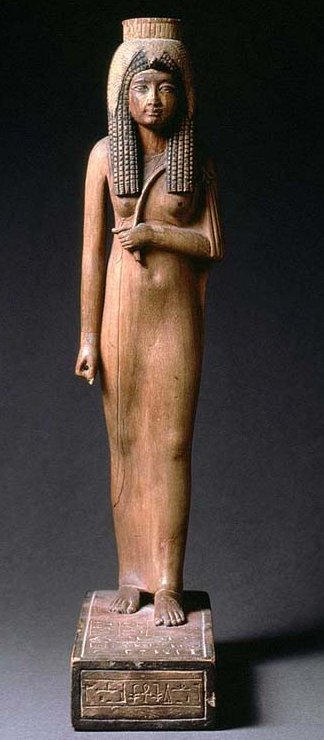
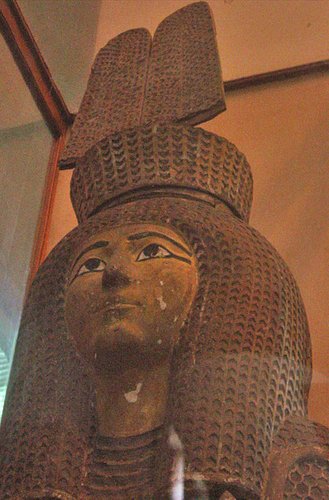
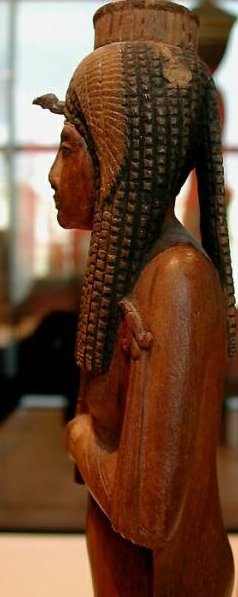
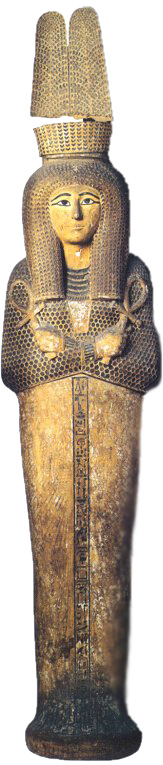
Made from wood and cloth, this colossal, wooden, anthropoid (mummy-shaped) sarcophagus of the Queen was originally inlaid with gold leaf (now lost since it was stolen by thieves). The body is decorated with a long row of Hieroglyphics of the "Hetep-di-nesu Formula" of offerings for the deceased's ka and "Sarcophagus Texts" that runs all the way up to stop at the crossed hands at the chest. The rest of the surface of the sarcophagus is ornamented with long feathers of birds which are thought to resemble the wings of the goddess Isis. With her fists only visible, she holds two large Ankhs (keys of life), the symbol of rebirth and eternal life. On her wrists, there is a pair of stripped bracelets with a similar shape. Framing the Queen's face is a large wig, over which rests a modius topped by a pair of ostrich feathers. Surprisingly, when the sarcophagus was opened, two mummies were found: the mummy of King Ramesses III as well as another of an unknown woman.
Facts
- Material: Wood & Cloth
- Found in: West Thebes, Cachette of Deir Al-bahari, 1881
- Discovered by: The Egyptian Antlquities Service
- Belonged to: Ahmes Nefertari
- Reign of: Ahmes
- Dynasty: 18th Dynasty
- Period: New Kingdom
- Museum: Egyptian Museum, Cairo
Related

Registration successfull!

Your Registration is successfully done
Please Check Your E-mail to Confirm Your Account. Do not forget to open the spam folder.
 EUR


 Español
 English
 العربيه


