Sarcophagus and Canopic Vases of Sheshonq II
This group of items was found by the French archeologist Pierre Montet in the grave of King Sheshonq II in an antechamber in the Tomb of Psusennes I, in Tanis. The tomb housed grave goods including gold funerary masks, coffins, gold masks, and numerous other items of precious jewelry belonging to Psusennes I, Siamun, Psusennes II, Sheshonq II, Sheshonq III, and general Undjebauendjed. This particular set consists of a silver falcon-headed sarcophagus and four canopic vases belonging to King Sheshonq II, the third ruler of the Twenty-second Dynasty.
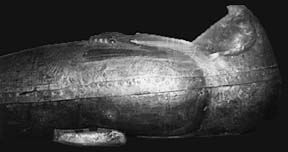
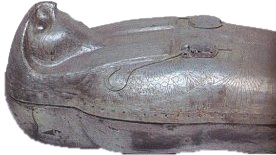
Ancient Egyptians paid much attention to the preservation of the dead body\'s viscera. The manner of treatment each internal organ of the body received varied according to the Ancient Egyptians\' perceptions of their significance. The brain was discarded, because its function was not understood. The heart was considered to be the physical \"centre\" of the individual and the location of the intelligence. The visceral packages were treated as miniature mummies, separately preserved and encased in containers which have affinities with full-sized coffins. The organs of Sheshonq II were placed in containers in the image of the King in the Osiride-form wearing a false beard and a royal nemes (Pharaonic headdress) with the uraeus serpent in the center. He is totally wrapped in bandages with only the fists visible. Below the fists are engraved some hieroglyphic inscriptions stating the names of the Four Sons of Horus who were believed to protect the organs: \"Imset, Duamutef, Hapi, and Qebehsenuef.\"
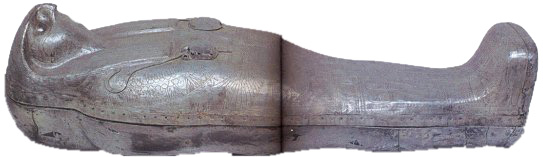
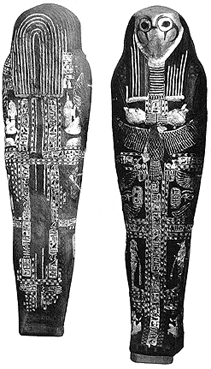
With the hands bearing the crook and flail of Osiris, the anthropoid sarcophagus denotes a high degree of accuracy and artistic value. Decorating the lid are depictions of feathers of winged goddesses (such as Isis and Nephthys). It denotes identification between both the King and Osiris-Sokari, an underworld, funerary god in the Memphis necropolis. The lower part of the sarcophagus is ornamented with a carving of the Sons of Horus facing one another in pairs.
Facts
- Material: Silver
- Found in: Tomb of Psusennes I, Grave of Sheshonq II, 1940
- Discovered by: Pierre Montet
- Belonged to: Sheshonq II
- Reign of: Sheshonq II
- Dynasty: 22nd Dynasty
- Period: Third Intermediate Period
- Museum: Egyptian Museum, Cairo
Related

Registration successfull!

Your Registration is successfully done
Please Check Your E-mail to Confirm Your Account. Do not forget to open the spam folder.
 EUR


 Español
 English
 العربيه


