Narmer
Narmer is the First Dynasty's first king whose name was known from later King Lists and from classical sources. In their own time, these kings were mostly known by their Horus names and not by their birth names which are used in the lists. As a result, both the identification and the existence of Menes are confused, but he is most probably the same as King Aha, whose reign dates back to the earliest tomb at Saqqara.
For this jumble, we are still in doubt whether the three names refer to one, two persons, or three different persons.
Painstaking by nature, the ancient Egyptians recorded in detail the contents of oil and wine amphoras. The informatio!1 was engraved directly onto jars or a sealed top or, as il this case, on labels tied to the neck of the container. The small ivory plaque wa\' engraved with a burin and found in the tomb of Quee I Neithhotep, Aha's wife. Horus the falcon is at the top right clutching the hieroglyphs that form the name of the king, Aha, \"Ih Fighter.\" Below a pavilion. the goddess-cobra Uadjel and the goddess-vulture Nekhbet stand over the hieroglyph men, meaning \"endure\" this scene might indicate the name of pharaoh Menes (men) and be dedicated to the two ladies. If that is the case, identification of Aha with Menes (the king cited by the Egyptian hlstonan Manetho as the first pharaoh of the First Dynasty) would be compatible With the version on the Palermo Stone, an important list of the kings of the first five dynasties which begins with Aha. However, it was only with the penultimate ki ng of the Fi rst Dynasty that the \"Two Ladies\" became one of the titles of the royal name, so it is more probable that the double symbol represents the name of the pavilion: nebly-men, i.e. \"the Two Ladies will endure\" (von Beckerath,1984). The decoration contiues with a boating scene and Horus over the cabin on a boat. A building decorated with a hhaheru frieze appears in the middle register; the frieze is a stylization of the knotted ends of the plant strips that were used to form the walls. Three long-haired figures appear inside: a dignitary with a long skirt and a staff watches the central scene where two men, perhaps priests, pour water inside what is probably a vase. Various offerings of loaves, jars, and oxen appear on either side . In the last register, four short-haired figures, perhaps servants, advance towards a group of hiroglyphs that specify the type of oil contained in the vase.
King Narmer's tomb was located at Abydos. Some objects dating back to his reign were found in the temples of Nekhen, Hierkonpolis, and Kom el-Ahmar.
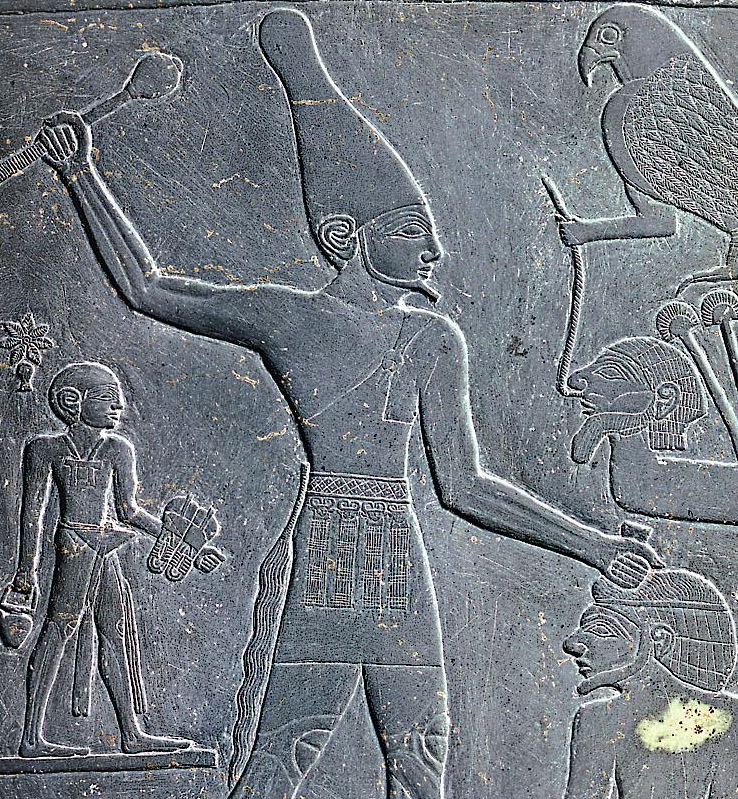
A slate palette of green schist displayed at the cairo Museum is ascribed to Narmer. On the palette's two sides, the scenes are different in their details, yet both commonly commemorate the King's victory over his enemies
Narmer Tablet is one of the most the prominent pieces admired for its highly significant scenes on its either sides indicating the Egyptians' celebration of the unity of Upper and Lower Egypt on the hands of King Narmer. The two sides of the tablet depict the victory of King Narmer over his enemy and the celebration of the annexation of Lower Egypt.
On one of the sides, Narmer is depicted as the victorious king of two lands wearing the crown of Upper Egypt and defeating his enemy and some hieroglyphics present him as the falcon Horus while holding the man of the papyrus land (the Delta) on a leash.
On the other side of the tablet, Narmer appears followed by followed by dignitary holding the royal sandals and preceded by some standards. The unity of Upper and Lower Egypt is symbolized by two mythical animals like long twined necks. the The carvings in the lower part of this side shows Narmer as a powerful bull attacking the fort of his enemy and overthrow his rival.

Registration successfull!

Your Registration is successfully done
Please Check Your E-mail to Confirm Your Account. Do not forget to open the spam folder.
 EUR


 Español
 English
 العربيه


