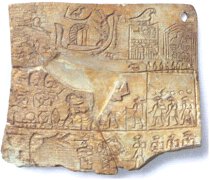
Label of Aha
Vase production in ancient Egypt started since the Predynastic period and then was developed and refined in the following eras. The vast production of vases by the cultures proceeding the historical epoch was enhanced in the final Predynastic period by new forms and decorations and by more advanced production techniques such as the hand-spun wheel.
This vase is a good example for vases of the Grezean epoch(Naqada 11) with its fine paste, closed designs, flat edges, and perforated handles through which a hanging cord could be passed. It is highly distinguished by its pinkish hues of the bottom are decorated with a series of dark red motifs distributed following the surface lines. Most of the paintings over the vases were imitating nature representing the earliest examples of pictorial art in ancient Egypt. This boat is ornamented with paintings for a rowing boat flanked with two cabins on either side. The anchor hangs below a long plume at the prow and the waters of the river are represented by wavy lines on the handles. In addition, the vase is ornamented with rows of stylized ostriches between thick aloe plants whose leafy branches on its either sides.
Facts
- Material: Ivory
- Size: height 4.8 cm, width 5.6 cm
- Found in: Naqada, Tomb of Neithhotep, 1904
- Discovered by: Garstang
- Reign of: Aha
- Dynasty: 1st Dynasty
- Period: Protodynastic Period and Predynastic Period
- Museum: Egyptian Museum, Cairo
Related

Registration successfull!

Your Registration is successfully done
Please Check Your E-mail to Confirm Your Account. Do not forget to open the spam folder.
 EUR


 Español
 English
 العربيه


