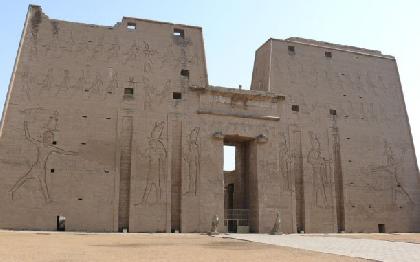
Religious features

The ancient Egyptians had a complex religious system that combined aspects of personal/family deities , city gods , and a very small number of national deities . The best way to understand it is: every city had its local deity and that deity was the principal god for that local population . There was also the only true national god and that was the king .
Again worship varied . There was individual prayer . There were community celebrations . There was worship and rituals within temples . Since the general populous could not go into the temples , there was no public worship in the temples . The major public worship ceremonies would be those where the god was carried out of the temple in a shrine and paraded around town for people to see and returned to the temple . Within temples an ordained/purified priesthood carried out the daily , monthly and seasonal rituals .
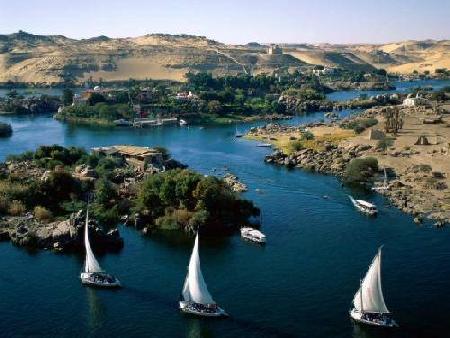
Also , many of the deities in ancient Egypt were related to natural phenomenon and worship may have been developed as a respect for that (such asrepresentation of the Nile floods , appearance of certain stars , beginning of growing season , etc . ) .

Christianity has recognized Sunday as the day of worship . Islam has Friday . Jews honor the Sabbath . Since the ancient Egyptians used a lunar calendar , all of their festival days are tied into lunar calendar dates . They also used a civil calendar and special national festivals were associated with the New Year time

This varies immensely by god . Some of the more common rituals include waking , feeding , bathing , clothing , singing to , and putting the god to bed in the evening . These would have happened on a daily basis . Each temple would have had additional rituals during the month .

Funerals seem to be times of transition for the deceased . They are passing from this life into the afterlife . The corpse and spirit are ritually brought to the tomb and a variety of rituals are performed to assist them in making the passage to the afterlife where they are reborn in the Egyptian version of paradise . The funerals include much weeping and wailing , but also include a festival meal and libations for the decease

There afterlife was a place where they were reborn in the company of the gods . It mainly included all of what they held dear in this world and many others , especially cool breezes , good food , a nice place to live , etc .

There afterlife was a place where they were reborn in the company of the gods . It mainly included all of what they held dear in this world and many others , especially cool breezes , good food , a nice place to live , etc .

This is a most discussed question . We assume that everyone could make it to the afterlife , but the social position of the dead in the afterlife mirrored that of the resent world . If you were a commoner here , you will be a commoner there .

They did fear death , but also recognized it was mainly an area that they have not experienced and thus that can be a very daunting thing .

Yes , they did both regular and burnt offerings . It was normal that the produce of fields owned by temples was offered to the gods . It normally happened that the priests were then given a portion of that as their salaries once the god had consumed that part which he/she wanted .

What was buried with the deceased was entirely based upon their social / economic standing . Wealthier people had more stuff , poorer had less . Wealthier people normally had better tombs , nicer coffins , etc . It truly was a reflection of their current wealth .

Not in the sense that some beliefs from India have the spirit reborn into a different or better physical form in this world . Rather we need to remember that their rebirth was confined to the afterlife .

Pyramids were restricted to those who could afford them such as kings and queens . We do see in the New Kingdom (1500 - 1100 BC) private individuals begin to place mini-pyramids on the tops of their personal tombs , but again those individuals were wealthy and could afford that extravagance .

The gods were in charge of maintaining the world . Thus the king did his job of maintaining the country in good order and the gods rewarded him with a long reign (or so the theory goes) . People worships the gods because the world belonged to them and if people disrupted the world , the gods could remove their protection over the people . It was definitely a system where the gods had the upper hand so to speak


Some damaged constructions within El Gundy Fortress


Map of Egypt
Map with coordinates, satellite images, zoom, attractions in Egypt   >>

Sightseeing in Egypt
Attractions, monuments, temples, restaurants, museums, sqaures, archelogical sites, and more in Egypt   >>

All Attractions of Egypt
A list of all attractions and monuemnts in Egypt   >>

Photo Gallery for Egypt
A nice photo gallery of special photos and photos sent by users about Egypt   >>

Current Weather in Egypt
Check weather state, dew, wind, cloud and temperature in Egypt   >>