Statue of Amun Pantheon
Found by the famous archeologist J.E. Quibell, this statue of Amun Pantheon is one of the exhibits in the Egyptian Museum that depict ancient Egyptian deities. Such kinds of statues witness considerable changes in the Egyptian mythology as a whole. In the Late Pharaonic Period, there had been a spreading belief in the combination of the divine aspects, sometimes even incompatible, of several deities and the result was a single deity with the combined elements and features. This religious development is known as the "pantheos" or "metaphysics".
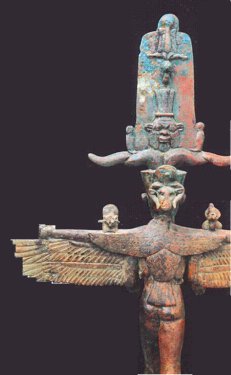
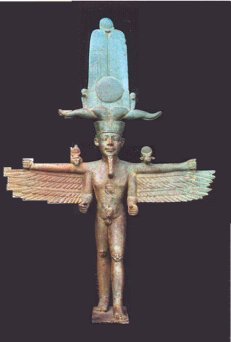
This bronze statue of the naked god Amun Pantheo stands on a plain square plinth with his left leg advanced. Highly admired are the two figures that represent the heads of two lions skillfully carved in minute detail over the statue's knees. Interestingly the statue has two bent arms (probably once holding scepters) and two extra arms with spreading wings. Resting on the additional upper arms are two faces of a baboon and a bull holding the solar disc on their heads. There is an engraved scarab on its chest. Fastened to the god's chin is a long accurately-carved false beard. Amun Pantheo wears the Atef Crown over his head, a triple crown; at the top it bears three sun disks with a cobra at each side. The crown rests on two ram's horns flanked by uraeus serpents. Interestingly the statue's back is covered with raised carvings of a huge hawk with wings outspread. From the back, one can see a ram's head adorning the headdress. The two horns are topped with a skillfully-portrayed face of god Bes crowned with its ears sticking out. The uppermost portion of the rear part statue is decorated with two ram's horns topped by the Atef Crown.
Facts
- Material: Bronze
- Size: height 45 cm
- Found in: Saqqara, 1912
- Discovered by: J.e. Quibell
- Museum: Egyptian Museum, Cairo
Related

Registration successfull!

Your Registration is successfully done
Please Check Your E-mail to Confirm Your Account. Do not forget to open the spam folder.
 EUR


 Español
 English
 العربيه


