El Fayoum Governorate

El Fayum is one of the governorates in the north-west of Egypt about 100km from Cairo . El Fayum is renowned for its fertile land , fascinating tourist attractions that date back to ancient Egyptian time and its great history .
The name of "El Fayum" comes from the Coptic word 'Phiom' , which means lake or sea since it was enclosing a sea in the Prehistoric period . Ptolemy II (Philadelophos) gave El Fayoum the name 'Philadelphia' . El Fauoum is also renowned for its Fayimian and Meorian Cultures that date back to the 5500 to 4000 BC . People of these cultures were sedentary and knew methods of agriculture and pottery making . With the climatic changes , around 4000 BC people began to abandon Fayoum and migrate to the Nile Valley , getting in contact with the people of Maadi Culture . However , El Fayoum remained a savage site for hunting and extracting mining salts . Thus , the Ancient Egyptians identified the lake of El Fayoum with some appropriate names , such as 'the Nun' or the Primeval Ocean , where life began . El Fayoum was the cult of Sobek god , the crocodile , and the lake of El Fayoum was regarded as a sacred place In the Old Kingdom and some temples were established for worshiping him .

In the Middle Kingdom the region of El Fayoum witnessed a great prosperity and a large number of temples were established . King Amen-Em-Hat (of the Twelfth Dynasty) chose the site of Lisht , on the midway between the Nile Valley and Fayoum , to be his residence . Amen-Em-Hat I built his pyramid there and it is thought also that he flooded Fayoum to create the Lake Moeris . During this dynasty , the whole region witnessed a wide scale development . El Lahun Pyramid , the colossi of Biahmu , the Labyrinth Pyramid all belong to this period .
During the Greek Period , the region prospered once again and hundreds of papyri found in different cemeteries of Fayoum provide much information on the booming life the Fayoumians led . But once the region began to decline by the 2nd century , it was gradually abandoned .
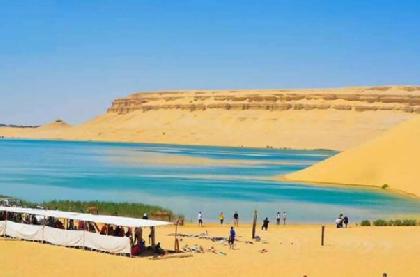
There are other monuments in El Fayoum including the famous for Karoun Lake and the Valley of Whales , with more than 500 skeletons of whales that are most popular tourist attractions in Egypt . Immersing in a plane view of the scene of the desert , one enjoys seeing a number of valleys , which once were rivers and lakes . In old times , people used to dwell there more than in the Nile Valley .

In addition to Lakes , tourist attractions El Fayum has become one of the major agricultural lands in Egypt that is rich in is regarded thanks to the improvement of communicational means , irrigation methods and investment in diverse crops .


The archeological site of the remains of Ancient Karanis, at Karanis Museum, Kom Oshim


Map of El Fayoum
Map with coordinates, satellite images, zoom, attractions in El Fayoum   >>

Sightseeing in El Fayoum
Attractions, monuments, temples, restaurants, museums, sqaures, archelogical sites, and more in El Fayoum   >>

All Attractions of El Fayoum
A list of all attractions and monuemnts in El Fayoum   >>

Photo Gallery for El Fayoum
A nice photo gallery of special photos and photos sent by users about El Fayoum   >>

Realestate in El Fayoum
Search or advertise for free your home, villa, commercial, office, apartment for sale or rent in El Fayoum   >>